Domain Driven Design
What is Domain Driven Design?
Firstly, when we ask what is Domain Driven Design (DDD) we actually want to understand the concept of Domain-Driven design. It is an approach to understanding a problem, designing it, and coding it at the end. It results in better, more testable, and maintainable code.
Secondly, understanding what is domain-driven design will help you communicate with your entire team on a different level. Through this improved communication you will become a better developer, leader, or key stakeholder.
Thirdly, within domain driven design, one major aspect is to design software that share key elements within the ‘real world’. Language used within software should be the same language used by the non-software people.
Finally, it is important to understand that this is not the only possible approach and it is not the single source of truth. However, if you do not know about it, you can not compare it with the others.
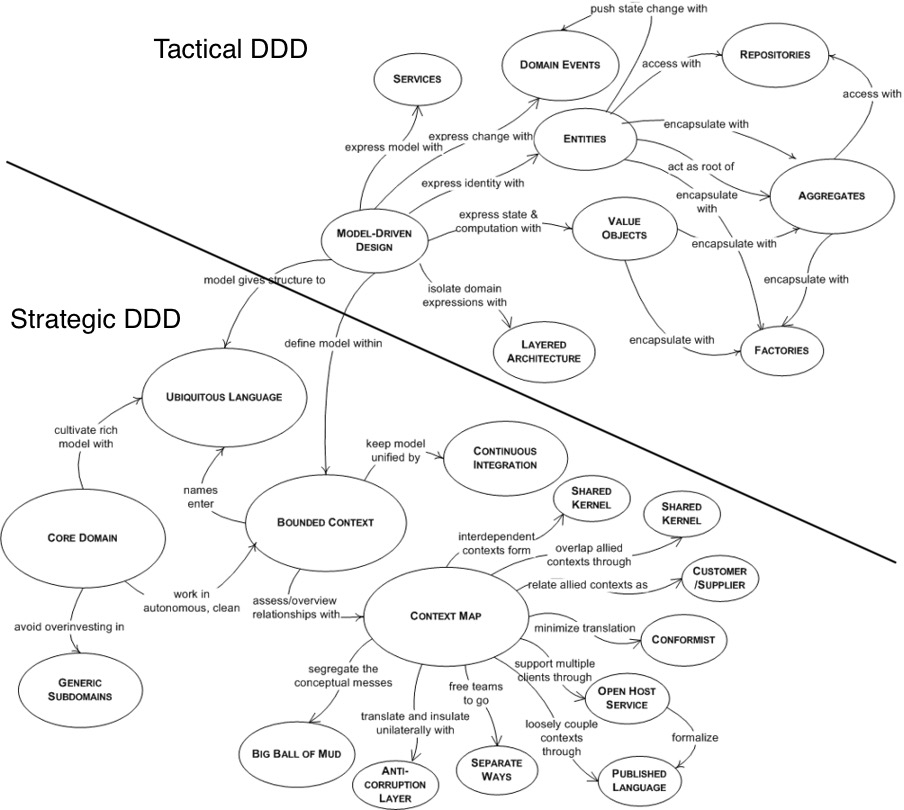
Strategic and Tactical DDD
Domain-driven design (DDD) is divided into strategic patterns and tactical patterns. The strategic pattern consists of things like bounded context, ubiquitous language, and context map; the tactical pattern consists of concepts like value types, entities, and aggregate.
Strategic patterns are easy to map to any language. They mostly cover a higher-level design of software like bounded context, context map, anti-corruption layer, patterns for bounded context integration. These patterns do not depend on the programming language or framework used.
However, the tactical pattern relies on programming language constructs and paradigms. We will further explore how some of these tactical patterns can be applied in functional languages without losing the true essence of functional programming.